
How to Choose a Reliable Metal Furniture Manufacturer: A Professional Buyer’s Guide
⚡ Quick Answer — What makes a reliable metal furniture manufacturer for OEM/ODM?
A reliable metal furniture manufacturer for OEM/ODM sourcing is one that can demonstrate — with physical evidence, not sales language — three verifiable capabilities: the engineering infrastructure to translate complex CAD designs into dimensionally consistent mass production; verified material compliance documentation (such as FSC certification for timber components); and the logistical expertise to deliver multi-material furniture through long-transit container shipping without structural or moisture-related failure. Price is rarely the variable that separates a successful sourcing program from a costly one. The audit criteria in this guide are.
Introduction: Sourcing Strategy Requires More Than a Price Comparison
Shifting furniture sourcing to Vietnam has become a well-established strategic response to the tariff pressures and supply chain disruptions of the past several years. What remains underappreciated is that the shift itself is not the hard part. The hard part is identifying, at the evaluation stage, which Vietnamese manufacturers have the production architecture to sustain quality, compliance, and delivery consistency at the volume your program requires — and which ones cannot.
As international buyer demand accelerates, understanding how to align with the right manufacturing scale is the first step in executing a successful furniture sourcing strategy in Vietnam for 2026. The evaluation framework in this guide moves the conversation beyond capacity claims and unit pricing into the specific production capabilities — engineering translation, prototyping fidelity, material traceability, and export logistics — that determine whether a sourcing program succeeds or generates remediation costs.
💡 Pro tip: Audit the factory, not the brochure
The most efficient early-stage filter for OEM/ODM manufacturer evaluation is a request for three documents: a sample QC inspection report from a recent export order, a material certificate (FSC or equivalent) for a timber component, and a packing list with photographic evidence from a prior container shipment. A manufacturer that can produce all three within 48 hours has an embedded compliance culture. One that cannot is describing what they intend to do rather than what they routinely do.
1. Core Evaluation Criteria for a Reliable OEM/ODM Partner
Three capability areas separate manufacturers who can sustain a multi-material OEM/ODM program from those who succeed on sample orders but fail at scale. Each area can be evaluated objectively during factory assessment — without relying on testimonials or self-reported quality scores.
📝 R&D and Engineering Translation
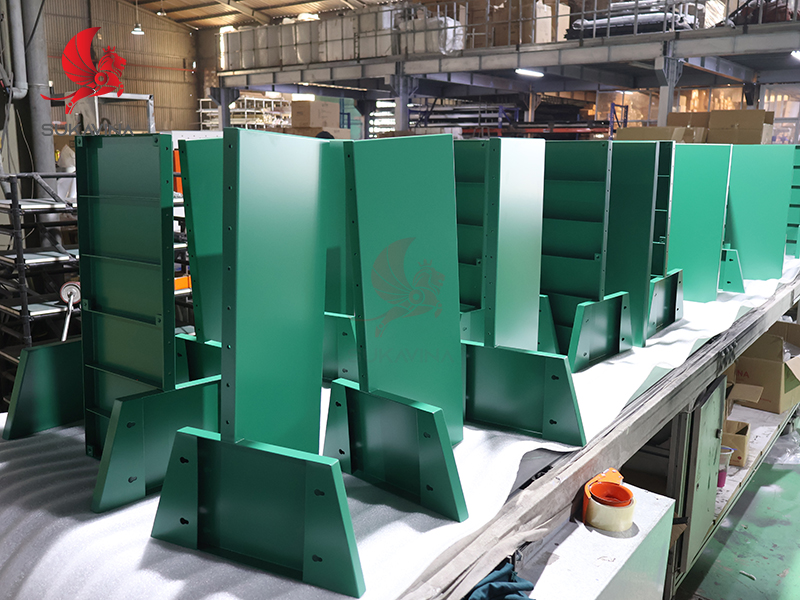
The ability to translate a buyer’s CAD design into mass-production reality — without introducing dimensional variance that accumulates across hundreds of units — depends on whether the factory’s engineering team and production equipment are genuinely integrated or merely adjacent. A factory where the design team works from a 3D parametric assembly model that simultaneously drives both the metal cutting NC program and the wood machining program has structurally eliminated the most common source of fit failure in combined furniture: two separate specifications interpreting the same drawing differently.
The practical evaluation question is direct: ask the factory to show you a CAD/CAM post-processing workflow document for a recent product. If both the metal and wood programs reference the same datum points from the same assembly file, the engineering architecture is sound. If the wood shop receives a 2D print drawn from the metal model rather than the model itself, accumulated tolerance is a known production risk that their QC process is compensating for rather than eliminating.
✅ Engineering Question to Ask
“Can you show me the CAD/CAM workflow for your last OEM product — specifically how the wood machining program is generated from the same model as the metal cutting program?” A factory with genuine integration can answer this in under five minutes with a screen walkthrough.
⚠️ Red Flag: Separate Drawing Systems
If the metal shop and wood shop each maintain separate 2D drawings derived from an original design, any revision to the product requires two parallel drawing updates — and any inconsistency between them becomes a production defect. This is a systemic risk, not an individual quality control failure.
📈 Tolerance Benchmark
For metal-to-wood furniture assemblies, a reliable manufacturer should achieve ±0.3mm or tighter at the metal-wood interface. Ask for this number explicitly and request a recent dimensional inspection report that documents it. Acceptable variance on paper and acceptable variance in practice are different claims.
📷 Prototyping Capability and Sample Fidelity
A sample that looks correct but fails to reflect the structural integrity and dimensional accuracy of the mass-production tooling is not a useful sample — it is a one-off artefact. The question to ask is not “how long does a sample take?” but “what is the relationship between your sample tooling and your production tooling?” In a factory with genuine prototyping capability, the sample is produced using the same jigs, cutting programs, and finishing standards as the production run, scaled to a 1–3 unit quantity. In a factory with limited prototyping infrastructure, the sample is hand-fitted and hand-finished to a level that production volume cannot sustain.
The commercial implication is concrete: a sample-to-production discrepancy on a 500-unit order typically surfaces at unit 50–100, when the manual fitting adjustments that made the sample work are no longer applied to every piece. By that point, the buyer has committed to a product specification and a delivery schedule that the manufacturing system cannot fulfil without rework.
🏭 Material Integrity and Verified Compliance
Material compliance documentation is not a bureaucratic formality for buyers sourcing into EU and North American markets — it is a customs clearance prerequisite. The EU Timber Regulation (EUTR) and its successor the EU Deforestation Regulation (EUDR) require documented proof that timber components do not originate from illegally harvested or deforestation-associated sources. In the US, the Lacey Act imposes equivalent obligations with criminal liability for importers who cannot demonstrate due diligence on timber provenance.
FSC Chain of Custody (CoC) certification is the most widely recognised mechanism for discharging this obligation. A manufacturer holding a valid FSC CoC certificate can supply timber components with documentation that directly satisfies EUTR/EUDR and Lacey Act due diligence requirements — eliminating the buyer’s need to conduct independent timber source verification on every order. Manufacturers without FSC certification place the compliance burden and legal risk on the buyer.
💡 Pro tip: Verify the FSC certificate number directly
FSC certificates are publicly searchable at info.fsc.org by certificate number or company name. Before proceeding past the RFQ stage with any timber-component supplier, look up their certificate directly — confirm the certificate is current, the scope covers the relevant product categories (not just raw timber), and the issuing date is within the current certification cycle. A certificate quoted in a sales deck but not verifiable in the FSC database is not a compliant certificate.
2. The Scalability and Export Reality: Sukavina’s Verifiable Metrics
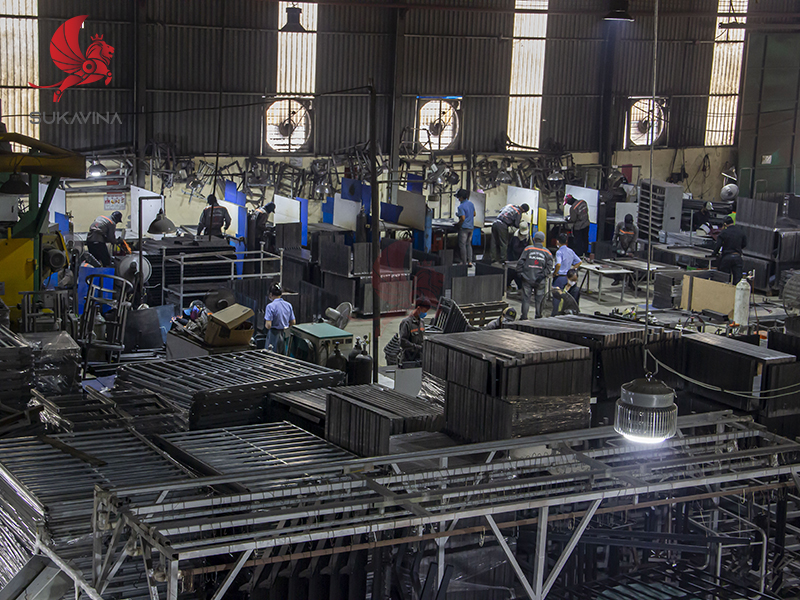
Generic capacity claims — “large factory,” “experienced team,” “competitive lead times” — are structurally uninformative for buyer evaluation. The relevant question is not whether a factory is large but whether its scale is structured to maintain precision and compliance simultaneously at the output volumes your program requires. The metrics below are drawn from Sukavina’s current production infrastructure and represent verifiable physical parameters, not promotional language.

| Metric | Sukavina Value | Why It Matters for Buyers |
|---|---|---|
| Total production floor area | 30,000 m² (3 facilities) | Sufficient physical separation of metal, MDF, and timber workflows to prevent cross-contamination of humidity and finishing chemicals |
| Dedicated MDF facility | 10,000+ m² (recently expanded) | Separate controlled-humidity environment ensures MDF components reach consistent equilibrium moisture content before CNC machining |
| Workforce | 600+ professionals | Dedicated engineering, production, and QC teams — not shared with general contract manufacturing |
| Monthly output capacity | 10,000+ units/month | Sustained throughput without sub-contracting that would introduce uncontrolled quality variance |
| Timber material certification | FSC Chain of Custody (CoC) | Direct compliance documentation for EUTR/EUDR and US Lacey Act — buyer due diligence obligation discharged at source |
| Timber moisture at machining | 8–12% EMC (measured per batch) | Prevents post-assembly shrinkage that would open metal-wood joints during container transit to US/EU markets |
| Export markets served | US, EU, Japan, Canada, 15+ countries | Familiarity with market-specific compliance requirements reduces buyer’s risk of customs-stage problems |
*Production metrics from Sukavina Group facilities, updated 2026.
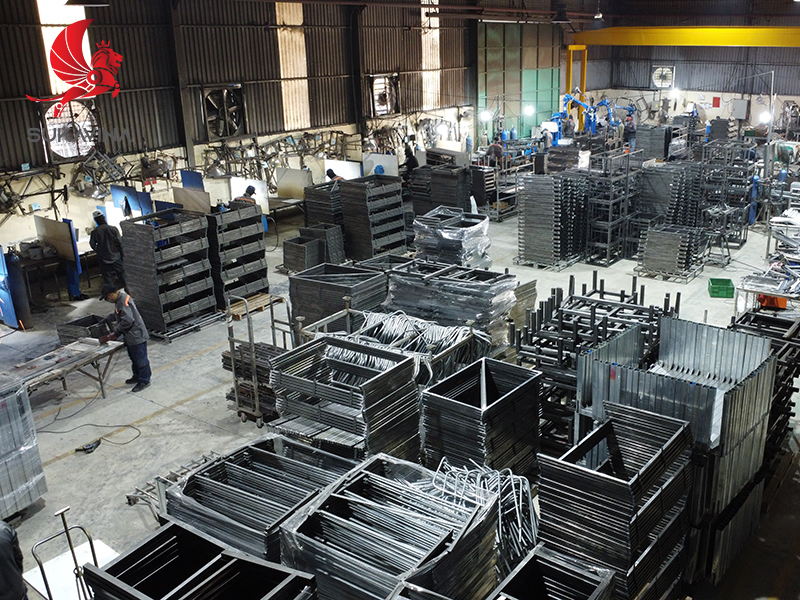
The scale described above is not valuable in isolation — it is valuable because it is unified. Choosing a partner with a 30,000 m² integrated production ecosystem completely eliminates the hidden risks of fragmented sourcing in multi-material furniture production, where components from separate workshops fail to align during final assembly, and no single party accepts accountability for the resulting defects.
📦 Export Packaging Standard
Each unit is individually wrapped in PE impact foam, secured in carton or wooden crate depending on the destination market’s handling requirements, and loaded on pallets with an optimised stacking plan that prevents compressive load failure during ocean freight. Packing list with photographic evidence is provided before container sealing.
🌡 Moisture Control in Container
Long-distance maritime shipping exposes timber furniture to humidity fluctuations that can cause dimensional movement and joint failure. By machining and assembling at 8–12% EMC — the equilibrium point for most air-conditioned indoor environments — Sukavina’s furniture arrives dimensionally stable regardless of container transit humidity.
📋 Knock-Down Packing Efficiency
All table and chair designs are engineered for knock-down shipping — tabletops and frames packed separately, assembled with M8 bolts on site. This reduces container volume by 30–40% versus fully assembled shipping, directly lowering the freight cost per unit to US and EU destination ports.
💡 Pro tip: Ask for an EMC log on timber batches
Timber moisture content at machining is a production variable that most factories do not proactively document unless asked. Request a timber batch moisture log for your order — it should show pin-type moisture meter readings per timber lot before CNC processing, confirming the 8–12% EMC target was met. This single document directly addresses the most common cause of post-delivery joint failure in solid wood and MDF furniture shipped to climate-controlled environments.
3. Frequently Asked Questions
❓ What is the standard lead time for OEM/ODM furniture prototyping and mass production in Vietnam?
At Sukavina, prototype development from approved technical drawing to physical sample runs 15–20 business days — including one design iteration review cycle. Mass production for orders of 200–500 sets follows an additional 25–35 business day production window after sample sign-off, with QC inspection and export packing adding 7–10 business days before container departure. Total timeline from final design approval to goods-ready-for-shipment is typically 47–65 business days depending on order complexity and current production scheduling. Buyers should factor sea freight transit time (14–28 days to US/EU ports) separately when planning opening or delivery dates.
❓ How do you verify material compliance for furniture exported to Western markets?
Sukavina’s timber components carry FSC Chain of Custody (CoC) certification, which is the primary mechanism for satisfying EU Timber Regulation (EUTR/EUDR) and US Lacey Act due diligence requirements. FSC CoC documentation traces timber from certified forest source through every stage of processing to the finished component, with a verifiable certificate number that buyers can confirm independently at info.fsc.org. For powder-coated metal components exported to the EU, REACH compliance test reports covering surface coating formulations are available on request. MDF panels used in production meet E0 or CARB Phase 2 formaldehyde emission standards, documented by third-party test reports retained per timber lot.
❓ How does a manufacturer handle the logistical risks of multi-material furniture during maritime transit?
Multi-material furniture faces two primary maritime risks: mechanical damage from vibration and compressive loading, and dimensional movement in timber caused by humidity fluctuation inside a container. Sukavina addresses the first through standardised export packing: PE foam wrapping per unit, structural carton or wooden crate per market, and palletised loading plans that prevent compressive stacking failure on soft components. The second is addressed upstream in production — timber is machined only after reaching 8–12% equilibrium moisture content, the stable range for most air-conditioned indoor environments, which means the furniture is dimensionally pre-adapted to its intended use environment before it enters the container. Transit damage across Sukavina’s shipping history runs below 0.3% of units per container.
Conclusion: The Right Partner is a Verifiable One
The decision to place a significant OEM/ODM furniture program with a Vietnamese manufacturer is not reversed easily once production tooling, mould costs, and sample sign-off are committed. The evaluation framework in this guide is designed to surface the specific operational gaps that cause programs to fail — not at the RFQ stage, but three or four months in, when a first production container arrives with fit problems or customs documentation that does not satisfy the importing market’s requirements.
A reliable metal furniture manufacturer is not distinguished by claims — it is distinguished by the consistency between what it demonstrates during factory evaluation and what it delivers across a production run of several hundred or several thousand units. The metrics in this guide — dimensional tolerance, FSC documentation, moisture control protocol, prototyping fidelity, and export packing standard — are all verifiable before an order is placed.
Sukavina Furniture is available to support factory evaluation visits, provide documentation for all compliance criteria discussed above, and produce prototypes from technical drawings or concept sketches for qualified prospective buyers. Contact details are below.
Complete Article Series: Working with OEM/ODM Furniture Manufacturers in Vietnam
| Part | Article Title | Key Question Answered |
|---|---|---|
| Part 1 | Why Global Brands Are Shifting Sourcing to Vietnam in 2026 | What macro forces make Vietnam the most strategically rational furniture sourcing destination in 2026? |
| Part 2 | The Hidden Risks of Fragmented Sourcing in Multi-Material Furniture Production | Why does buying metal frames and wood components from separate factories consistently produce quality failures? |
| Part 3 | High-Tech vs. High-Touch: Achieving the Perfect Finish in Metal-Wood Furniture | How does fiber laser precision and artisan hand-finishing work together to produce export-grade surface quality? |
| Part 4 ◀ | How to Choose a Reliable Metal Furniture Manufacturer: A Professional Buyer’s Guide (You are here) | What specific criteria — engineering, compliance, capacity, logistics — should a buyer audit before committing to an OEM/ODM partner? |
Ready to Evaluate Us?
Request a factory documentation package — FSC certificate, QC inspection report, and container packing example — from Sukavina Group within 48 hours.
📍 SUKAVINA CO., LTD.
• Address: Binh Chuan 44 St, An Phu Ward, Ho Chi Minh City, Vietnam
• Hotline: +84 979 034 634 / +84 931 155 155
• Email: sales@vietmetalfurniture.com
• Website: sukavinafurniture.com