
Modular Coffee Tables: The Future of Flexible Living Room Design
One table, three setups, infinite configurations. The modular coffee table is quietly replacing the fixed centrepiece — and once you understand why, a single rigid table will never feel like enough again.
The living room centrepiece has always been the coffee table — the anchor around which sofas orbit and conversations unfold. But in 2026, that centrepiece is no longer a single fixed object. The modular coffee table — a system of independent organic shapes that cluster, separate and reconfigure without tools — is redefining what the heart of the living room can do. It is the logical companion to the warm minimalism trend 2026: fluid, warm, tactile and endlessly adaptable.
Rigid single-piece coffee tables are being replaced by modular systems in 2026 because compact urban apartments demand furniture that earns its floor space across multiple functions and configurations. A modular coffee table made from two or three independent organic shapes — circles, soft teardrops, curved contours — clusters into a sculptural centrepiece for daily living and splits apart effortlessly for entertaining, floor activities or smaller rooms. The result is a living room that breathes, adapts and stays visually calm regardless of how the day — or the floor plan — changes.
- Adaptable Footprint: cluster or separate modules in minutes to match the moment, not the furniture.
- Multi-room Utility: one module migrates to the bedroom as a side table; another becomes an entryway accent piece.
- Fluid Visual Flow: curved silhouettes guide the eye gently around the room, eliminating dead corner zones and rigid sight-blocking geometry.

Independent organic modules: a coffee table that reconfigures as life demands.
1. What Is a Modular Coffee Table System?
A modular coffee table is not a single object with removable legs. It is a family of two to four independent table pieces — each with its own organic silhouette, its own height, its own surface — designed so that their shapes nest, overlap or separate without visual conflict. Think of them as puzzle pieces that work both together and apart: a large circle, a soft teardrop, a kidney-curved oval, each complete on its own and richer in combination.
Why Organic Shapes Are Non-Negotiable
Rectangular modules would fight each other when clustered — gaps would be angular and awkward, and the composition would read as a scattered office desk rather than an intentional centrepiece. Circles, teardrops and soft ovals cluster without dead zones: their edges complement rather than conflict, producing a composition that reads as one sculptural object even when three separate pieces are involved.
Combining modular flexibility with rounded contours directly reflects the broader adoption of organic shaped furniture 2026, where rigid boxy designs give way to fluid shapes that soften both the room and the daily routines played out within it.
- Circle: the anchor — typically the largest diameter (ø60–80cm), primary surface for drinks, books and objects.
- Soft teardrop or kidney: the companion — tucks against the circle’s curve when clustered, floats as a side table when separated.
- Small oval or pebble: the accent — lowest height, used as a footrest surface or pulled forward as an individual guest table.
Vary the heights across your modules by 8–12cm. A flat cluster reads as one heavy surface; a staggered cluster reads as sculpture. The height differential also creates natural zones — high surface for drinks, low surface for books — without any visual clutter.
2. Three Layout Scenarios for Compact Living
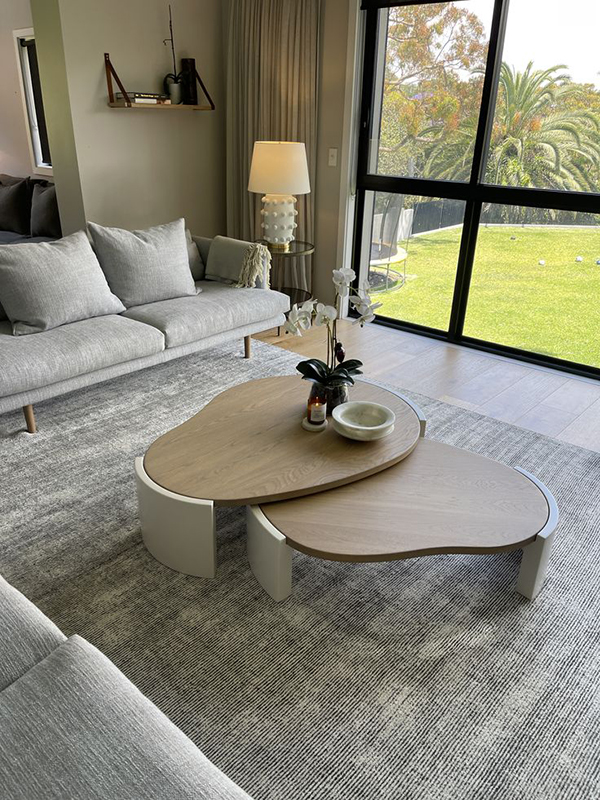
Three setups, one system: the modular table reconfigures in minutes.
This is where a reconfigurable design earns its floor space. In a 40–50m² apartment, the living room is never just a living room — it is a workspace, a dining overflow, a yoga studio on Sunday morning. Each scenario below takes the same set of modules and solves a different version of that day.
Scenario 1 — The Cluster Setup: Everyday Centrepiece
Push all modules together in front of the sofa, nesting their organic edges into a unified composition. The large circle anchors the centre; the teardrop tucks against its left curve; the small pebble overlaps slightly at lower height. From above, the cluster reads as one intentional sculptural piece — from the sofa, it provides the full surface area of a conventional coffee table while feeling considerably lighter and more dynamic.
- Best for: daily living — morning coffee, evening books, a candle grouping.
- Styling tip: place one raw ceramic object on the tallest module and leave the lowest surface completely bare.
Scenario 2 — The Social Setup: Distributed Guest Tables
When guests arrive, separate the modules and distribute them throughout the seating arrangement: one beside each sofa end, one in front of an armchair, one within reach of a floor cushion. Every seat now has its own surface — no one is reaching across the room for a drink. The living room converts from a two-person daily space into a fluid social configuration that seats six or eight comfortably without a single piece of new furniture.
- Best for: dinner parties, long evenings, hosting without a dining room.
- Styling tip: keep each separated module bare except for one glass or one small candle — simplicity keeps the room from feeling cluttered when pieces are spread out.
Scenario 3 — The Nested Setup: Instant Floor Freedom
Stack or fully nest the modules — smallest fitting beneath or beside the largest — and slide the compact grouping toward the sofa or against the wall. The floor opens immediately: enough clear space for a yoga mat, a children’s play area, or simply the rare luxury of an unobstructed room. The reconfiguration takes under sixty seconds and requires no lifting, no tools and no rearrangement of surrounding furniture.
- Best for: morning exercise, floor seating, or simply recovering space when the room feels small.
- Styling tip: keep the sofa’s throw and cushions in place — a clear floor against a styled sofa reads as intentionally calm, not empty.
3. Material Harmony & Tactile Warmth
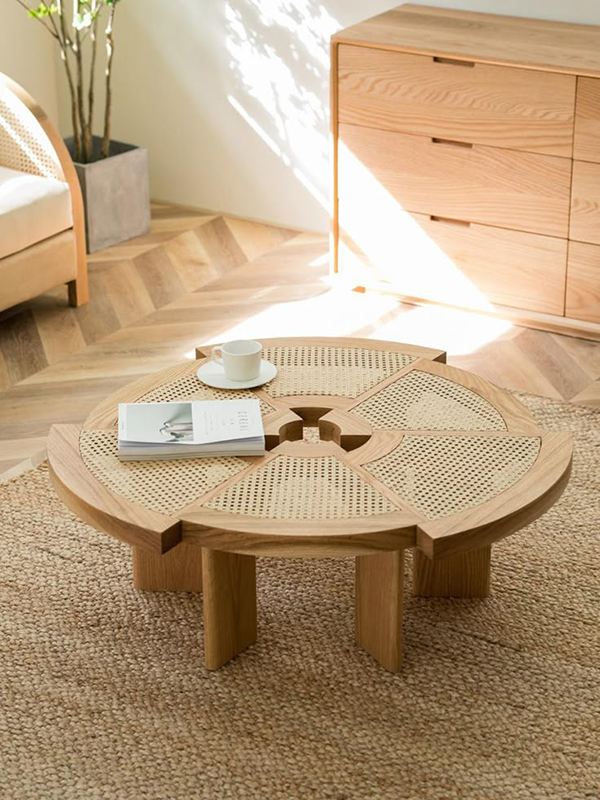
Warm grain and matte neutral surfaces: the material pairing that grounds the living room.
A modular system that reconfigures freely must also hold together visually across its configurations. Material consistency is what makes that possible: when every module shares the same warm-wood-and-matte-neutral language, separated pieces still read as belonging to each other — and to the room.
The Two-Material Formula
The same pairing that defines a light wood and bouclé bedroom works with equal elegance at the living room floor: warm oak or ash-veneer surfaces paired with slim matte black iron frames. The wood provides organic warmth and grain interest; the iron legs keep the visual mass low and the silhouette airy.
- Surfaces: natural oak, pale ash or warm MDF veneer in oat or honey tones; matte-lacquered for durability, oil-finished for depth.
- Frames: tubular or tapered matte black powder-coated iron, leg diameter no wider than 12mm to preserve the floating quality.
- Alternative surface: textured plaster or lime-wash MDF in warm white for modules that need to read lighter against a dark floor.
- Finish consistency: all modules in the same surface treatment — mixing gloss with matte breaks the system’s visual unity across configurations.
This material language pairs naturally with the curved beige sofas that define 2026’s living room aesthetic: the sofa’s organic silhouette and bouclé softness need a grounded, warm-wood counterpart at floor level to complete the composition.
4. Buyer’s Guide: How to Choose Your Modular System
Not all modular sets reconfigure with equal elegance. The difference between a system that works and one that simply looks good in the showroom comes down to four precise decisions: diameter, height variation, edge profile and material finish. Get these right and every configuration looks intentional. Get them wrong and even a clustered grouping reads as accidental.
The Four Buying Decisions
| Decision | Recommended Range | Why It Matters |
|---|---|---|
| Anchor diameter | ø60–80cm | Large enough to anchor a 2–3 seat sofa; small enough to navigate around in 40m² |
| Companion diameter | ø35–50cm | Two-thirds of the anchor — visually balanced when clustered, genuinely useful when separated |
| Height differential | 8–12cm between tallest & lowest | Creates sculptural stagger without mismatched proportions; prevents flat, heavy silhouette |
| Edge profile | Minimum 4mm radius soft edge | Sharp MDF edges chip; soft rounded edges survive daily contact and read warmer at knee height |
| Frame leg diameter | 8–12mm iron tube | Thin enough to preserve the floating quality; thick enough to carry 15–20kg per module |
One Rule Above All Others
Buy modules from the same collection, not from separate ranges mixed together. Even minor surface-tone differences between batches — one oak slightly pinker, one slightly greyer — break the system’s visual unity the moment pieces are separated across a room. A single manufacturer’s range guarantees batch consistency across every module you add now or later.
Choosing three modules all at the same height because “it looks balanced in the photo”. Identical heights work only in the clustered position — the moment you separate modules across a room, every piece reads as a misplaced coffee table rather than a deliberate accent piece. Varied heights give each module its own identity.
FAQ — Modular Coffee Table Questions Answered
Click each question to read the full answer.
📝 Final Thoughts: Buy for the Room You Live In, Not the One in the Photo
A fixed coffee table is a commitment; a modular system is a conversation. It adapts to Tuesday morning yoga, Saturday evening guests, and the smaller flat you might move to next spring — all with the same warm wood grain and slim iron silhouette anchoring every version of the room.
- ✓ Start with two modules: anchor circle ø60–80cm + organic companion ø35–50cm.
- ✓ Vary the heights: 8–12cm differential between tallest and lowest module.
- ✓ Match the material language: warm wood surface + slim matte iron frame throughout.
- ✓ Buy from one collection: finish consistency is what makes the system hold together separated across a room.
The shift toward reconfigurable, organic-shaped living room furniture is one of the clearest signals in the European furniture trends 2026 data — and the modular coffee table sits exactly at its centre.

• Address: Binh Chuan 44 St, An Phu Ward, Ho Chi Minh City, Vietnam.
• Hotline: +84 979 034 634 / +84 931 155 155
• Email: sales@vietmetalfurniture.com
• Website: sukavinafurniture.com